
 Search
The Site
Mill River: Water Power and Water Supply
The Mill River, which flows through the Whitney Armory site is on its way to Long Island Sound, has played a crucial role in its history. Eli Whitney, Sr. came to the site in 1798 specifically in order to use the water's power for running machinery; sixty-two years later his son turned the river into the first public water supply for the city of New Haven. For some decades thereafter, the river continued to provide power not only for the Armory's machinery, but also for pumping its own water into the network of pipes reaching New Haven's buildings and hydrants. Eventually it gave way, as a power source, to steam engines and electric motors, but it continues to this day to supply water for the city.
The low dam and waterwheels that Eli Whitney, Sr. installed made possible the Whitney Armory with its adjacent small settlement, Whitneyville. Like many another New England water-privilege site, but unlike the larger planned waterpower complexes such as Lowell or Holyoke in Massachusetts, the community remained of modest size. Constrained in large part by the natural limits on its water power, Whitneyville did not grow into an industrial city, but led him first in the 1840s to replace the waterwheels with hydraulic turbines, the latest advance in waterpower technology, and then to make the dam five times higher in 1860. The other purpose of this move - to form Lake Whitney as the as the first reservoir for the New Haven Water Company - was what paid for the construction of the dam we see at the site today. The creation of Lake Whitney in turn prevented further industrial development at waterpower sites upstream - by flooding them - thus leaving the Armory as southern Hamden's only industrial site until a later era.
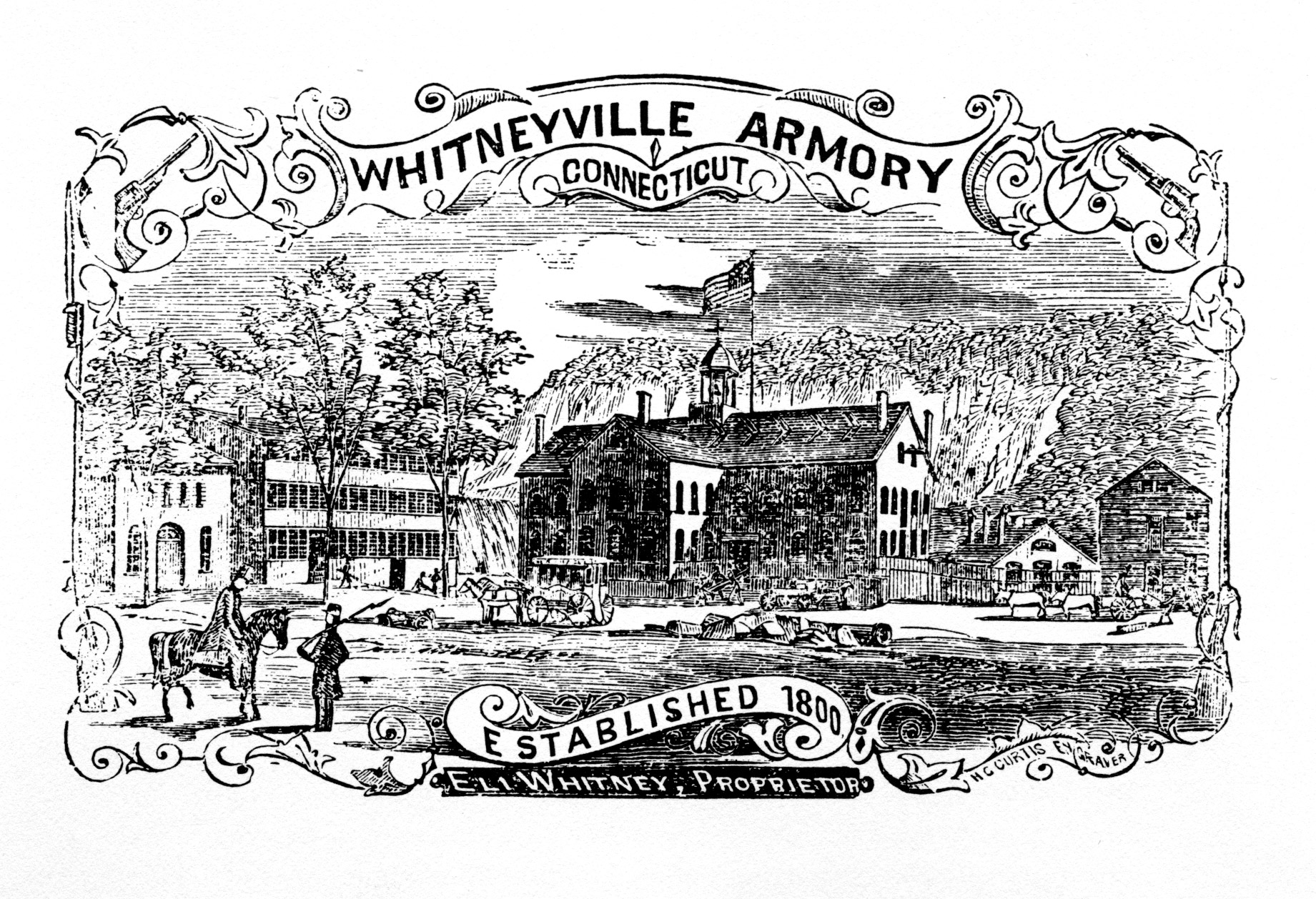
Whitney's Improved Fire-Arms Advertisement, c. 1862
New Haven Colony Historical Society
From the book, Windows on the Works: Industry on the Eli Whitney Site 1798-1979
The Mill River, Lake Whitney, and the Waterworks
Eli Whitney’s armory was built along the Mill River for two reasons: water power and transportation. At the site, the low ridge of land that connects East Rock and Mill Rock created a natural waterfall in the Mill River, perfect for supplying power via a water wheel. Additionally, the Mill River was tidal up to the waterfall. Shallow-bottomed boats could travel from the Armory and through the river’s marshes below East Rock before joining the Quinnipiac River estuary and, only a few miles away, New Haven Harbor. This made it easy to transport supplies like iron and charcoal to the site and to distribute finished products.
The Grist Mill
In 1640, the early New Haven colonist Sergeant William Fowler built a mill at the waterfall below East Rock. The river that powered the mill was named after it, as was the rocky outcrop that rose to its west: the Mill River and Mill Rock.
By 1665, Fowler’s mill had burned down - a frequent fate of mills, because flour is highly flammable. William Bradley and Christopher Todd rebuilt the mill. Todd and his family operated it for many years, leading it to be known as “Todd’s Mill.”
The millers improved the natural water power of the site by building a small dam across the waterfall, creating a millpond. From the pond, water could be released through a mill race, a small channel that directed at the waterwheel.
The mill was built to grind grains like corn or wheat into meal or flour. Grain intended for grinding is known as “grist”, and mills that produce flour are known as grist mills. The flour was needed to feed the new and growing New Haven Colony. Today, you can still see millstones at the Eli Whitney Museum and Workshop along the walkway between the Main Building and the Carter Studio. They are a record of the deep industrial history of the site.
[IMAGE: MILLSTONES?]
The mill below East Rock was the first of many mills and factories along the Mill River. It changed hands several times in the next 150 years. By the 1780s, it was owned by the Sabin family. In 1787, the Sabins sold it to James Hillhouse, Charles Channey, and Pierpont Edwards, business partners who were planning to build the Hartford and New Haven Turnpike through the property. These men in turn sold the mill site to Eli Whitney in 1798 for his new armory.
Crossing the River
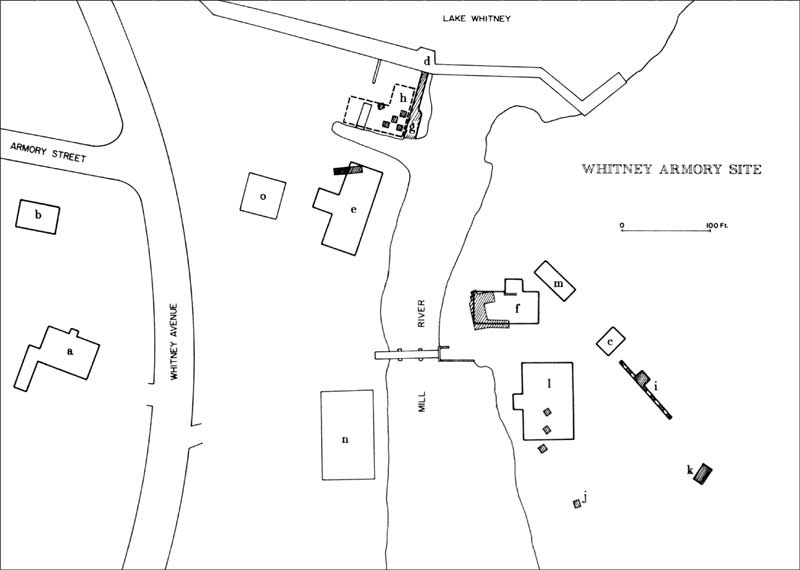
The Whitney Armory site is divided in two by the Mill River. The main armory workshop buildings stood on the west bank of the river, where the EWMW’s workshop and exhibit buildings now stand. The east bank was the site of the forge and coal store and other auxiliary buildings. A simple, low wooden bridge linked the two sides of the river. It was supported by stone piers which survive and now support the replica of the Town Bridge. The original Town Bridge lay just north of the Armory where the Turnpike crossed the river.

CAPTION: View looking east across the Mill River, 1906. The bridge linking the two sides of the Armory site is at center. Library of Congress Prints and Photographs Division, HAER CONN,5-HAM,3-17.

CAPTION: Photograph from around 1870, taken from the roof of one of the Armory workshop buildings, looking south along the Mill River with East Rock in the background. The Forge can be seen at left. The wooden bridge sits on stone piers that still exist. Library of Congress Prints and Photographs Division, HAER CONN,5-HAM,3B-7.
Lake Whitney
In 1859, Eli Whitney Jr. started building a much larger dam at the Armory site, creating Lake Whitney. The dam and lake would solve two problems: the need for more water power at the Armory and the need for water in New Haven.
The dam was built with stone quarried from East Rock and Mill Rock. When completed, it was 38 feet high and 500 feet long.
The new lake stretched north for 2 miles. Three mills were submerged. 20 buildings were relocated to escape the water, as were three bridges, including the Town Bridge.
The original dam and reservoir have been expanded twice since 1862.
When Eli Whitney made his plans to supply the government with muskets, water power and machines were two of his immediate concerns. The third, but no less important component of his scheme for a gun manufactory on the Mill River was a workforce. And Whitney had given considerable thought to what characteristics he wanted his workers to have:
My intention is to employ steady sober people and learn them the business. I shall make it a point to employ persons who have families, connections, and perhaps some little property to fix them to the place - who consequently cannot be easily removed to any considerable distance.
How well Eli Whitney succeeded in recruiting "steady, sober people" is not clear. Research that can tell the story of the Whitney workers, their relationship to Whitney and each other, their feelings about their jobs, and the changes that occurred in both their domestic and vocational choices is only now beginning.

Boarding House, now the Connecticut Trust for Historical Preservation
Preliminary appraisals suggest that the social microcosm that Whitney created at Mill Rock fits no easy model. We know that the buildings on the west side of Whitney Avenue had a primarily social rather than a manufacturing function. Despite some ambiguity concerning its date and construction, the boarding house for unmarried workers, located at the corner of Whitney Avenue and Armory Street, was probably one of the first structures that Whitney built after completing those structures essential to the gunmaking operation. The series of buildings on Armory Street that Whitney built for his married workers no doubt followed close behind. Benjamin Silliman wrote that they were "beautifully constructed and arranged upon one plan. And William P. Blake, a son of Whitney's nephew, Eli Blake wrote that there were,
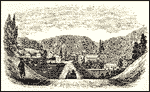
Whitneyville in 1832, engraving by J.W. Barber
From the book, Windows on the Works: Industry on the Eli Whitney Site 1798-1979
ten or more dwellings besides the boarding house, erected for the convenience and comfort of the operatives. The village, built by the elder Whitney (the first 'Whitneyville) consisted of six houses of stone, covered with stucco... Some of these buildings were removed when the construction of the high dam rendered a change in the direction of the road necessary.

Waterfall built by Eli Whitney, Jr. in 1860
The remaining houses were torn down in 1912. Finally, the Barn, built in 1816, was the centerpiece of the Whitney farm. It was the focus of agricultural activities which supplied the boarding house kitchen and provided shelter for the draft animals used at the Armory. Whitney's friend Silliman considered it "a model of convenience and even taste and beauty," and further described the unique features of its design:
It is perfectly characteristic of Mr. Whitney that his attention was directed to the mangers for his cattle, and to their fastenings. The latter are so contrived, by means of a small weight at the end of the halter, that an animal could always move his head with perfect facility, but could not draw out the rope so as to become entangled in it, nor could he easily waste his hay. The fastenings of the doors, as well as all the other appendages and accommodations are equally ingenious.
That Whitney took an active role in the design and construction of the non-Armory buildings on his site is thus well established. The need for housing to accommodate his workforce was obvious given the distance of the Armory from any other suitable lodgings. The farm was necessary to provide food for the unmarried workers and probably supplemented the gardens of the married workers living on Armory Street.

The Town Bridge
In 1820, the architect Ithiel Town wrote to Eli Whitney requesting a written opinion of the model of a wooden bridge on which Town that year had filed a patent. Whitney's reply, "its simplicity, lightness, strength, cheapness & durability, are in my opinion such as to render it highly worthy of attention," recognized the admirable qualities of Town's bridge, which was in fact a major design innovation.
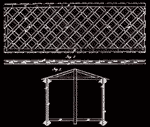
Town's Patent Drawing of the Lattice Truss, 1820
Ithiel Town Papers, Yale University Library
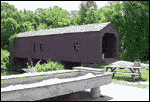
A current view of the bridge
The lattice truss was an uninterrupted series of closely spaced diagonal timbers. The resulting web of overlapping triangles affected the distribution of stress to all members, so that the independent action of any one triangle was impossible. Ordinary pine or spruce planks were used for the diagonals and wooden connecting pins or tree-nails fastened the members at their points of intersection. This "garden trellis fence" concealed a truss design of considerable strength.
Not only was Town's design strong and made of economical standard-dimension lumber, it was also easy to build: it did not require fancy mortises and tendons and could thus be erected by a common carpenter's gang; it did not have to be custom-fitted to piers or abutments as arch bridges did. And the lightness of its timbers reduced the amount of labor that had formerly been needed to erect the pioneer bridges of Town's predecessors, Timothy Palmer and Theodore Burr. Thus the lattice-truss bridge combined the features of strength and economy, which had great appeal, especially to those engaged in the expansion of the nation's transportation network of highways and later, railroads.
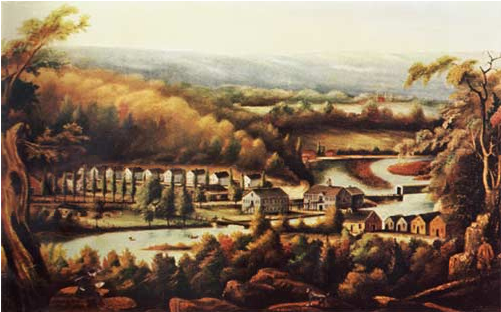
Whitneyville 1825
In 1827, William Giles Munson drafted a now famous portrait of Whitneyville, the manufacturing village that Eli Whitney had developed for 25 years. Whitney died in 1825. Munson's painting records buildings Whitney had built or had planned. Painters, journalists and presidents visited Whitneyville. It was an accessible and popular sampler of change that was sprouting next to rivers all over New England.
Munson's Whitneyville is thoughtfully organized, peaceful, and in easy harmony with the river and hills that surround it. By the time the Industrial Revolution had reached full force, few factory towns kept Whitneyville's idyllic balance. Munson's painting is an image that finds its way into text books that describe the beginning of the Industrial Revolution in part because it recalls a beginning of friendly human scale and dignity not yet darkened by smoke.
Factories are places of change. At least 18 buildings have come and gone since Whitney Sr's time. We are still digging into that history. With the painting and map, however, you can still find artifacts of Whitney's era and mind.
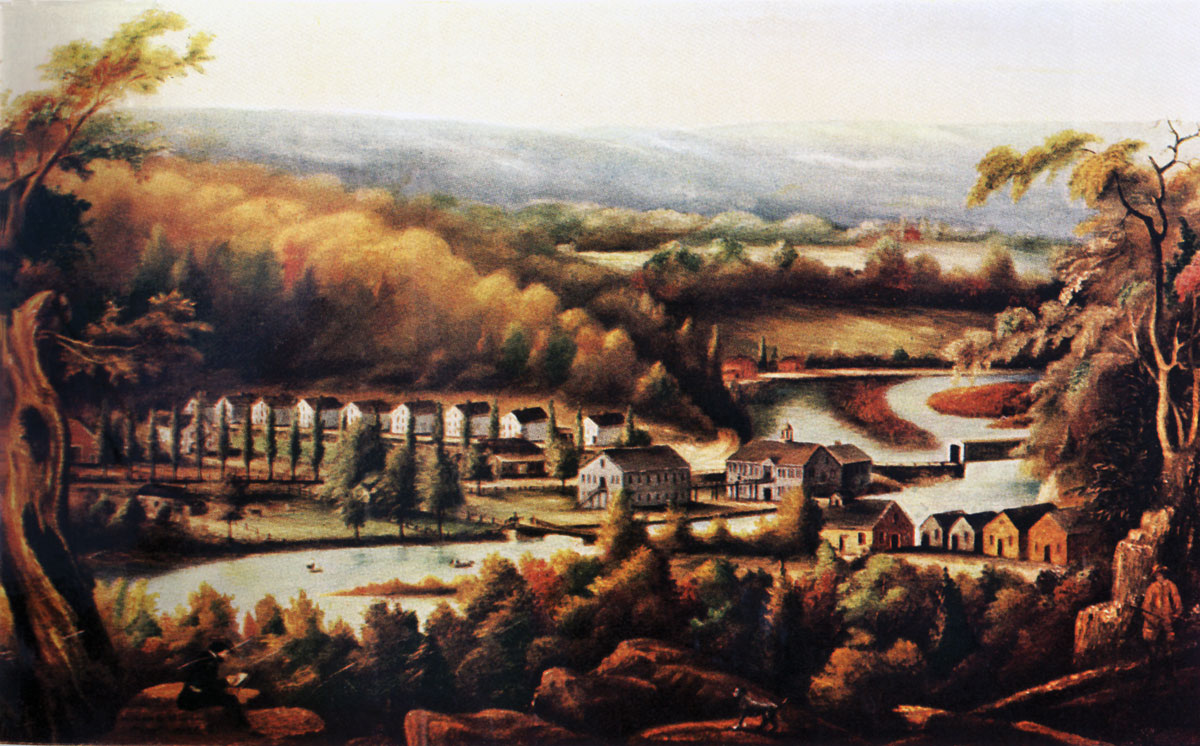
The Eli Whitney Gun Factory by William Giles Munson, oil on canvas, 1826-8. Courtesy of the Yale University Art Gallery, Mabel B
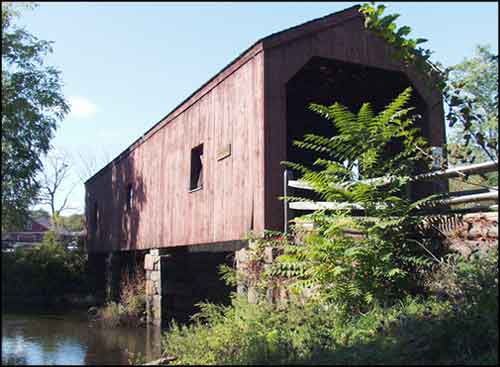
Bridge Abutments 1822
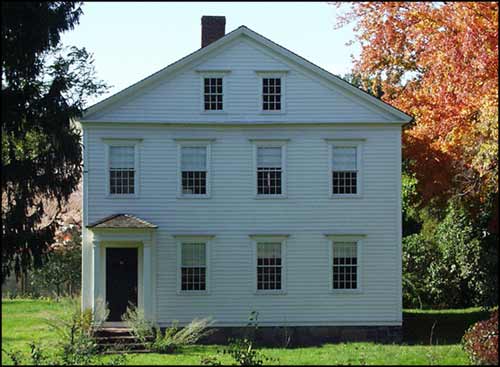
New Boarding House 1825
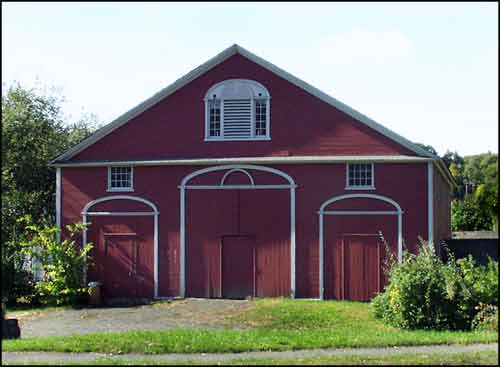
Barn 1816
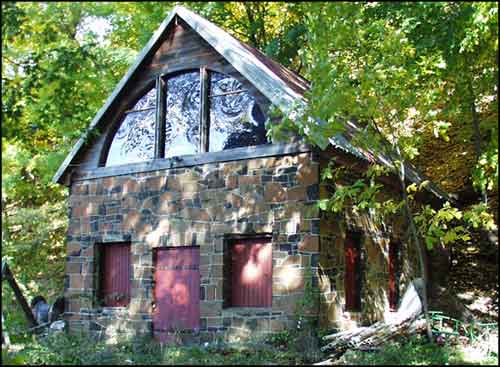
Coal Storage Shed 1803
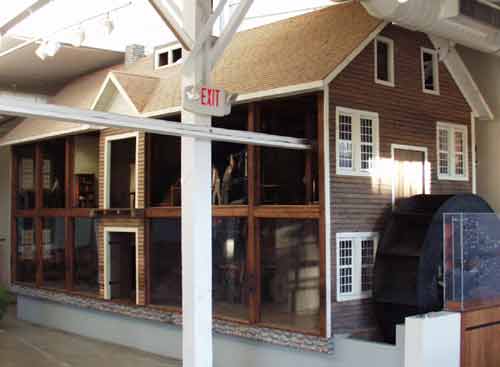
Armory 1798
Whitney's Improved Fire-Arms Advertisement, c. 1862 - New Haven Colony Historical Society From the book, Windows on the Works: Industry on the Eli Whitney Site 1798-1979
Boarding House, now the Connecticut Trust for Historical Preservation
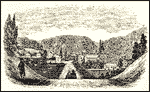
Whitneyville in 1832, engraving by J.W. Barber From the book, Windows on the Works: Industry on the Eli Whitney Site 1798-1979
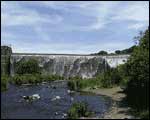
Waterfall built by Eli Whitney, Jr. in 1860
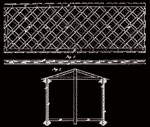
Town's Patent Drawing of the Lattice Truss, 1820 Ithiel Town Papers, Yale University Library
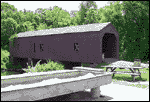
A current view of the bridge
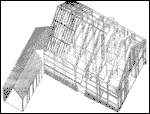
Drawing of the barn, from Eli Whitney's Gun Factory
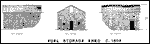
Drawing of the fuel shed, from Eli Whitney's Gun Factory
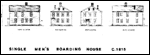
Drawing of the men's boarding house, from Eli Whitney's Gun Factory
Second-Armory-Image-grey
ARMORY