
 Search
In 1787, James Hillhouse and his business partners bought the site of the grist mill below Mill Rock. Hillhouse was a prominent New Haven lawyer and politician. He had a plan to construct a new road between New Haven and Hartford. This road would provide a much-needed transportation link between the new state’s two biggest cities and shared capitals.
Unlike today, in the 1700s state governments did not build roads. Instead, groups of private investors could create turnpikes. In exchange for building and maintaining the roads, the government allowed the turnpike corporations to make a profit from collecting tolls.
The Hartford and New Haven Turnpike Company was officially created in 1798, the same year Hillhouse leased the grist mill site to Eli Whitney for his Armory. The road opened in 1799. Eli Whitney was a shareholder.

The Turnpike was constructed to follow as straight a line as possible between the New Haven and Hartford courthouses. It ran north from New Haven on what is now Whitney Avenue. At the northwest corner of the Eli Whitney Museum and workshop property, Whitney Avenue meets Lake Whitney and turns slightly to the west. Until the construction of the dam and the creation of Lake Whitney in 1861, the road would have continued straight to cross the Mill River. In 1823, the Town Bridge was built to carry the Turnpike across the river. A replica was built on the EWMW property in 1979.
The Hartford and New Haven Turnpike’s straight route can still be seen on maps of Connecticut. On the other side of Lake Whitney, the road is still called Hartford Turnpike. It continues north through Hamden then parallels Highway 15 (Wilbur Cross Parkway) before meeting Highway 5 (Berlin Turnpike) at Yalesville. In south Hartford it becomes Maple Avenue, and finally Main Street in downtown Hartford.
The Town Bridge
Ithiel Town (1784-1844) was a pioneering American architect and engineer based in New Haven. As well as designing many well-known buildings in New Haven and across the newly formed United States, in 1820 he patented a revolutionary new design: the lattice truss bridge.

Town had a strong professional relationship with Eli Whitney Sr. and asked him for comments on the bridge design. Whitney was impressed, writing that the design’s "simplicity, lightness, strength, cheapness & durability, are in my opinion such as to render it highly worthy of attention."
Town’s design seemed strong, but it still needed to be tested. In 1823, Whitney and Town agreed that Town would build his very first lattice truss bridge to carry the Hartford and New Haven Turnpike across the Mill River just north of the Armory site.
Whitney’s words proved true: the bridge over the Mill River was successful and Town soon was selling the design up and down the East Coast. People wishing to use the design paid Town by the foot: the wider the bridge’s span, the more they owed him. This arrangement made Town a very wealthy man.
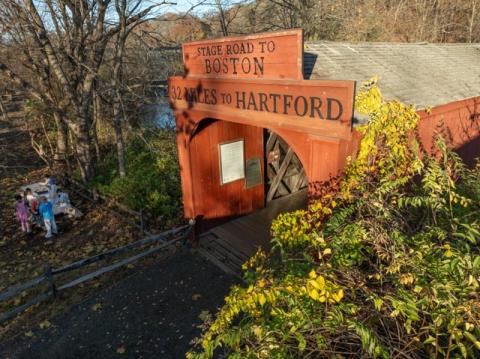
In 1859, Eli Whitney Jr. began building a new dam at the Armory site. Ithiel Town’s bridge couldn’t stay where it was: it would get covered by Lake Whitney. The bridge was still in such good condition that rather than destroy it, Whitney Jr. had it moved north to where Davis Avenue now crosses the lake.
The original Town bridge was destroyed in flooding in 1890. The version now on the EWMW grounds is a replica built by students from Eli Whitney Technical School in 1979. It stands on the location of a simple bridge that linked the two sides of the Armory site.