
 Search

The inventor Eli Whitney, Sr. is known for two innovations that had major impacts on American history: the cotton gin and the promotion of interchangeable parts in industrial production.
Whitney was born in Westborough, Massachusetts in 1765. He was the son of a prosperous farmer. From a young age, he was interested in engineering, industry, and business. At age 14, he recognized a need in his community: people needed nails for building projects, but imports from England had stopped and the local metalworkers had other work to do. Whitney opened his own nail-making workshop to supply his neighbors. In early pursuits like the nail workshop, Whitney learned through material explorations, failures, and successes, developing the knowledge, skills, and resilience he would use throughout his life. These were the building blocks for what would become the Whitney Armory.
As well as being a skilled maker, Whitney showed academic promise. He was interested in attending college, but family circumstances prevented it. He saved his own money to support his education and enrolled at Yale College in 1789, at the age of 23. At the time, many students entered college in their mid-teens and finished their studies before they turned 20. Yale University’s Eli Whitney Students Program is named in honor of Whitney’s achievement - it supports non-traditional undergraduates who enter the university more than five years after completing high school.
After graduating from Yale in 1792, Whitney traveled towards South Carolina with the intention of becoming a tutor to wealthy children to earn money for law school. At the invitation of a fellow traveler, he visited a plantation in Georgia, where he learned about the slow process of removing seeds from cotton fibers. At the time, this work was done by hand by enslaved workers. Whitney soon invented a machine that could do the work much more efficiently: the cotton gin. The machine was a success, leading to a boom in cotton agriculture and manufacture as well as an expansion of the violent systems of plantation enslavement.
The cotton gin was hugely successful, but it was easily copied by other makers, and Whitney struggled to enforce his patent. As a result, Whitney did not benefit from his machine’s success. In an attempt to make more money on the invention, he built a cotton gin factory in New Haven in the mid-1790s. However, it soon burned down, and Whitney looked to other projects.
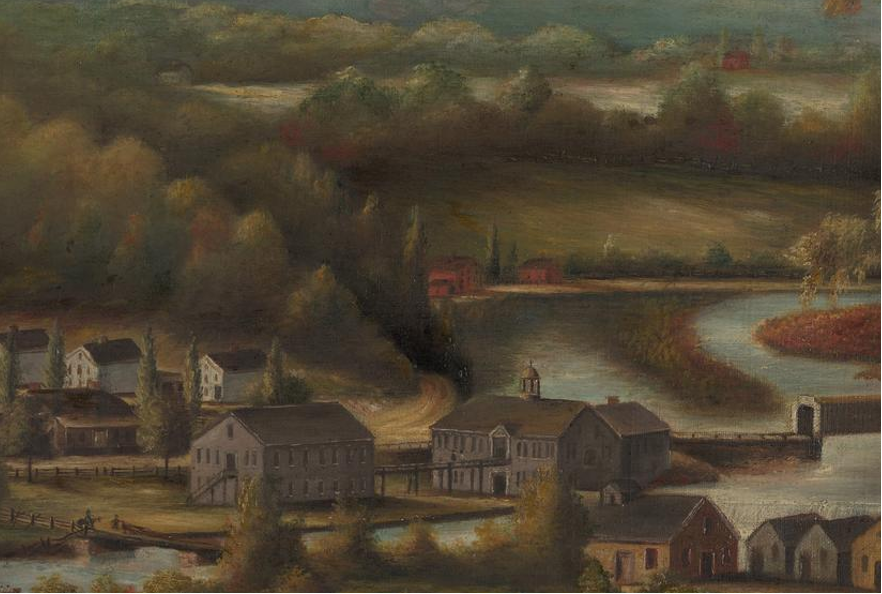
In 1798, Whitney secured a contract from the United States government to manufacture 10,000 muskets and established an armory at a site between New Haven and Hamden on the Mill River. The site is now the Eli Whitney Museum and Workshop. The Whitney Armory manufactured guns for government contracts and the civilian market for the next 90 years, developing many innovations along the way.
Whitney’s goal, like that of many manufacturers at the time, was to develop a system of precision manufacturing to improve efficiency and cost-effectiveness, replacing slow, expensive hand-making. This system would have produced industrially-produced, identical parts that everyday laborers could assemble into identical products. These parts could also be interchanged across the identical products, making them easier to repair. Whitney never achieved his full goal, but he, his employees, and his peers developed new processes that were important steps on the road to modern industrial production.
Many of the Armory’s processes, including finishing the metal gun components and assembling them into the wooden gunstocks, still required extensive hand-work during Whitney’s lifetime. As a result, he developed an apprentice system to train workers. He also developed a settlement where his workers to live: Whitneyville.
In the 1800s, Connecticut and Western Massachusetts were the heart of gun manufacturing in the United States. Whitney likely traded ideas with other manufacturers in the area, such as Simeon North of Middletown, who is credited with creating one of the first American milling machines. He also was in frequent correspondence with the government’s armory in Springfield, MA. Workers also moved between the different armories operating in the area, bringing their expertise with them. This shared inventive spirit lives on today in the EWMW’s hands-on learning programs
After Eli Whitney
When Eli Whitney Sr. died in 1825, his son Eli Whitney Jr. was only four years old. The elder Whitney’s nephews Philos and Eli Whitney Blake took over the business. The Blake brothers were inventors and engineers in their own right, and they continued to update and improve the Armory and its machinery. It is likely that the ‘Whitney’ milling machine, the oldest-known surviving American milling machine, dates from the Blake period.
In 1835, the Blake brothers left to set up an architectural fittings firm. The Armory was then managed by the trustees of Whitney’s estate, Henry W. Edwards and James Goodrich, until Eli Whitney Jr. was ready to inherit.
In 1840, the twenty-year-old Eli Whitney Jr. completed his degree at Princeton and took over the Armory. He expanded and modernized the Armory’s site and production methods. In 1843, he collaborated with Samuel Colt to produce the first Colt Revolvers. In 1860, he built a new dam at the site, creating Lake Whitney, improving water power for the Armory, and creating a water supply for New Haven’s growing population.
Whitney Jr. sold the Armory to the Winchester Repeating Arms Company in 1888. Later owners of the site continued to pursue the Whitneys’ legacy of industrial innovation and invention until the last factory on the site closed in 1979.