
The Mill River, Lake Whitney, and the Waterworks

Water: Power and Transportation

Before the introduction of steam engines in the early 1800s, work was completed by human or animal strength or with wind or water power. Water was the most consistent possible power supply and essential for operating any kind of heavy machinery.

In water-powered mills, water would run past a wheel, pushing and turning Shafts connected to belts and pulleys that delivered power to machines. The belts and pulleys could be set up in many different ways. The first water wheels at the Armory were undershot wheels, powered by water running below them. 
 

Basic operation of undershot water wheel. Wikimedia Commons.


To supply the water to power the wheel, mills or factories were built where there was a reliable, powerful flow of water, like where a stream descended a slope. The Armory site is an example of this. Before the Lake Whitney Dam was built, there was a small natural waterfall where the Mill River meets the low ridge that connects the higher outcrops of East Rock and Mill Rock.

[LEARN MORE: GEOLOGY AND THE QUARRY]

The Armory site was also perfect for transportation. The Mill River was tidal up to the waterfall. Shallow-bottomed boats could travel from the Armory and through the river’s marshes below East Rock before joining the Quinnipiac River estuary and, only a few miles away, New Haven Harbor. This made it easy to transport supplies like iron and charcoal to the site and to ship finished products to buyers.

The Grist Mill

In 1640, the early New Haven colonist Sergeant William Fowler built a mill at the waterfall below East Rock. The river that powered the mill was named after it, as was the rocky outcrop that rose to its west: the Mill River and Mill Rock. Fowler and later owners improved the natural water power of the site by building a small dam across the waterfall. This created a millpond. From the pond, water could be released through a mill race, a small channel that directed at the waterwheel.

The mill was built to grind grain into flour. Grain intended for grinding is known as “grist”, and mills that produce flour are known as grist mills. The flour was needed to feed the new and growing New Haven Colony. Today, you can still see millstones at the Eli Whitney Museum and Workshop along the walkway between [building names]. They are the oldest artifacts at the museum, a memorial to the deep industrial history of the site.
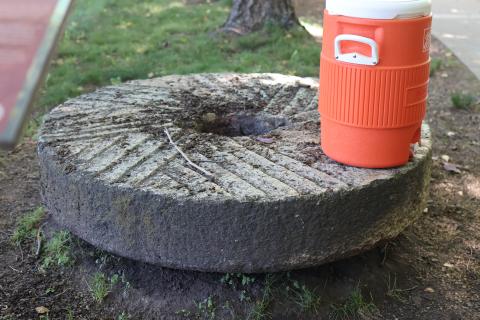
Fowler’s Mill was the first of many mills and factories along the Mill River. It changed hands several times in the next 150 years but stayed in operation. When Eli Whitney came to the site in 1795, there was still a grist mill and pond. By the 1800s, the Mill River also powered 13 other factories.

[IMAGE: MILLSTONES?]

[LINK: Potential longer piece about water power???]

Lake Whitney

In 1859, Eli Whitney Jr. started building a much larger dam to create Lake Whitney. The dam and lake would solve two problems: the need for more water power at the Armory and the need for water in New Haven.

The dam was built with stone quarried from East Rock and Mill Rock. When completed, it was 38 feet high and 500 feet long.

The new lake stretched north for 2 miles. Three mills were submerged. 20 buildings were relocated to escape the water, as were three bridges, including the Town Bridge.

The original dam and reservoir have been expanded twice since 1862.

Water Power at the Armory

Water from the Mill River powered the machines in the Whitney Armory, including the main Armory building and the forge. An archaeological dig in the 1970s revealed the path of the forge tail race, which returned the water to the Mill River near the island.

However, as the Armory grew and its machinery became more complex, its original 6 foot high log dam, small millpond, and undershot waterwheels were not providing enough power. After he took over the Armory in the 1840s, Eli Whitney Jr. set out to solve this problem. In 1848, he introduced a more efficient vertical wheel contained in an iron housing. This type of wheel turned sideways, rather than up and down. It was far more compact - 4 feet in diameter, versus the 14 foot undershot wheel already used at the site - but much more efficient.

By the late 1850s, the Armory again needed more power. Lake Whitney would provide much more water to power new turbines.

The Armory and later occupants of the factory site continued to improve the turbine system as technology advanced. Water power was used at the site until 1933, when the last of the machinery was converted to electrical power. The final turbine building and the large metal pipe that fed it are still visible at the EWMW site.

New Haven Water Company

Like many cities, New Haven grew rapidly in the 1800s. In 1800, the population was around 4,000. In 1850, it was 20,000. In 1860, it was almost 40,000. The new residents were attracted by the city’s industrial boom, but the many new factories greatly increased the risk of fire. There was no city water supply, so fire prevention was difficult, and residents relied on wells to drink. Unfortunately, there was also no city sanitation system, meaning those wells were often unsafe.

The city needed a solution. In 1849, a group of New Haven civic leaders had founded the New Haven Water Company to create a city water system. They struggled to raise money and to overcome political opposition to their plans. In the late 1850s, Eli Whitney Jr. took over the company and began building the Lake Whitney Dam and the planned waterworks at the Armory site.

As well as the dam, the Water Company built water-powered pumps, a reservoir, and eighteen miles of pipe to carry water to New Haven. The system opened on January 1, 1862. The company provided water to private properties, fire hydrants, and public water fountains like the one built on New Haven Green. In 1871, the company introduced steam pumps to increase the efficiency of the waterworks. The pumps were housed in a pump house that still stands on Armory Street.

The NHWC grew with New Haven, acquiring other local water companies, building more reservoirs, and expanding the water system. In 1980, the company became part of the South Central Connecticut Regional Water Authority (RWA). Lake Whitney is still part of the RWA system and supplies part of New Haven’s water.

After a 1901 outbreak of typhoid fever, a waterborne disease, the NHWC built a water purification facility across Whitney Avenue from the Armory and Waterworks property. A purification plant still operates there today, and a new facility was built in 2005. It includes the distinctive shiny, steel-clad building that you can see from Whitney Avenue, Armory Street, and East Rock. Around the purification plant, the RWA built a public park that also embraces two historic buildings from Eli Whitney Sr.’s time: the boarding house [LINK] and the 1816 Barn [LINK], which is part of the EWMW.


Sources:
https://www.newhavenarts.org/arts-paper/articles/water-they-doing-in-th…;
https://www.rwater.com/about-us/storied-history/ 
http://www.waterworkshistory.us/CT/New_Haven/