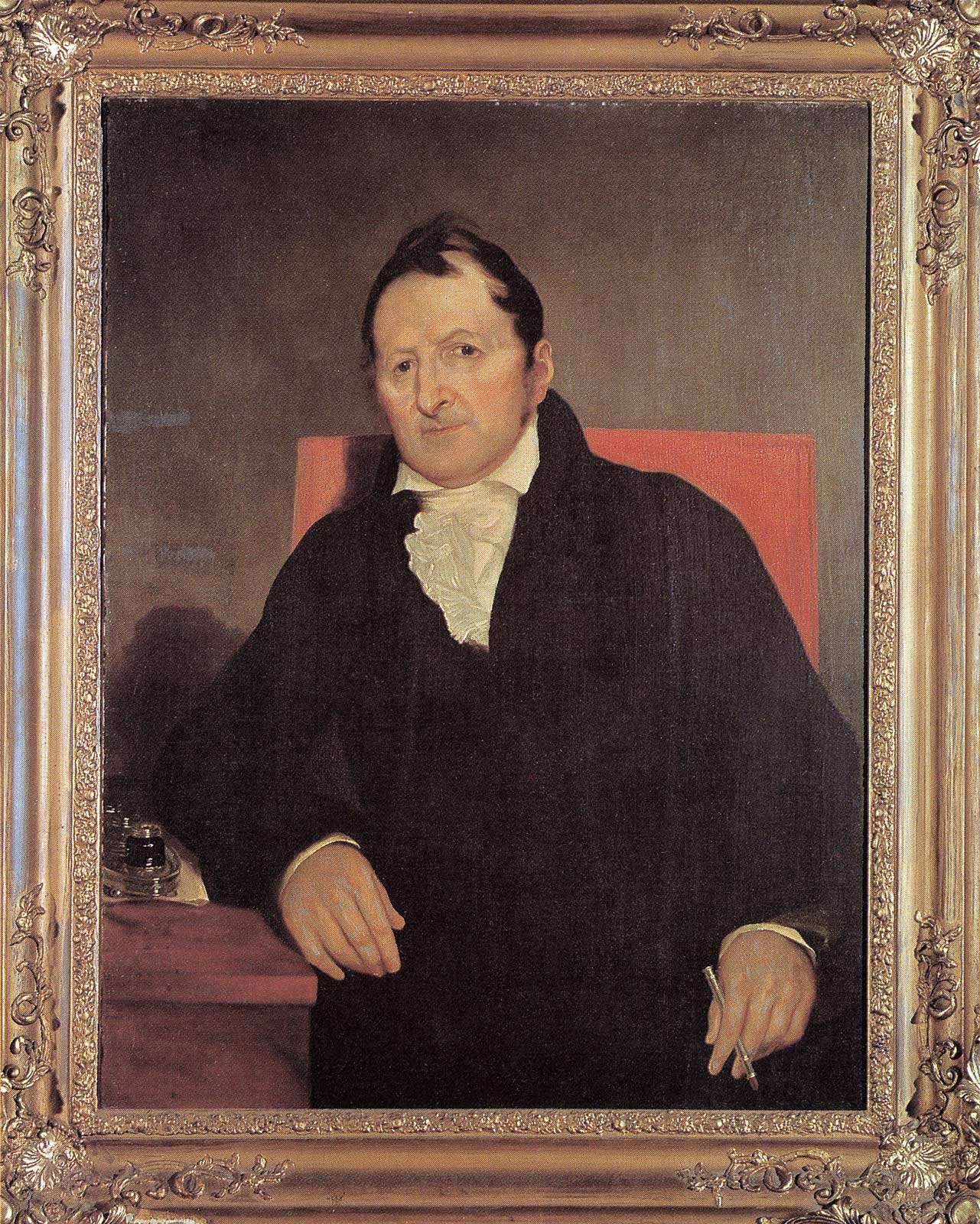
From: American Science and Invention: A Pictorial History
Mitchell Wilson, Simon and Schuster, New York, 1954; pp. 78-83

|

|

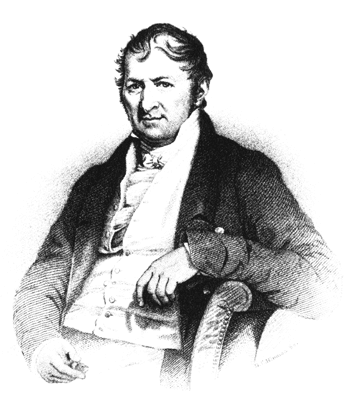
From: American Science and Invention: A Pictorial History
Mitchell Wilson, Simon and Schuster, New York, 1954; pp. 78-83
Of all the post-Revolutionary Americans who grew up without knowing the name for what they felt within themselves, Eli Whitney had the most tortuous career. Yet more than any other one man, he shaped the opposing faces of both the North and South for a half-century to come. By 1790 slavery was a declining institution in America. Apart from tobacco, rice, and a special strain of cotton that could be grown only in very few places, the South really had no money crop to export.
Engraving of Eli Whitney,
by Samuel F.B. Morse, c. 1822
New Haven Colony Historical Society
Sea Island cotton, so named because it grew only in very sandy soil along the coast, was a recent crop and within a short time was being cultivated wherever it found favorable conditions. Tobacco was a land waster, depleting the soil within very few years. Land was so cheap that tobacco planters never bothered to reclaim the soil by crop rotation -- they simply found new land farther west. The other crops -- rice, indigo, corn, and some wheat -- made for no great wealth. Slaves cost something, not only to buy but to maintain; and some Southern planters thought that conditions had reached a point where a slave's labor no longer paid for his maintenance.
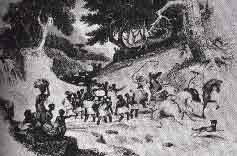
Jefferson and Washington were not untypical of their times in their attitude towards slavery; it was a cruel system, and the sooner the South was free of it, the better everyone would be. Some slaves were freed; and many masters, including the more human, planned on manumission at their own deaths.
Whitney came south in 1793, when the Southern planters were in their most desperate plight. In ten days he worked the most fateful revolution in a regional economy that ever occurred. Floods and earthquakes are cataclysmic; but their effects are forgotten and the scarred earth heals. Whitney's cataclysmic invention was the start of an avalanche. In the South, nothing was ever to be the same again.
Whitney's boyhood was precocious in a way that his neighbors could not comprehend. He had an instinctive understanding of mechanisms. It was a medium in which he could improvise and create in exactly the same way that a poet handles words or a painter uses color.
During his youth, the tall, heavy-shouldered boy with large hands and a gentle manner was a blacksmith, a nail maker on a machine he made at home and at one time, he was the country's sole maker of ladies' hatpins.
In his early twenties, Whitney determined to attend Yale College, so unusual a step for anyone not preparing for either the law or theology that his parents objected. He was twenty-three before he got away from home and twenty-seven when he received his degree, almost middle-aged in the eyes of his classmates. Again the most serious drawback facing him was that no profession existed suited to a man of his talents. Whitney settled for teaching (he had taught while attending Yale), and accepted a position as a tutor in South Carolina that promised a salary of one hundred guineas a year.
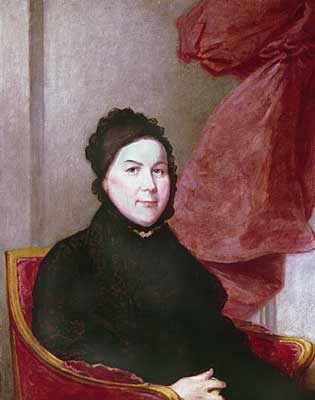
He sailed on a coasting packet that took a few passengers, among whom was the widow of the Revolutionary general, Nathaniel Greene. The Greenes had settled in Savannah after the war. When Whitney arrived, he found to his disgust that the promised salary was going to be halved. He not only refused to take the post, but decided to give up teaching as well. Mrs. Greene invited him to accompany her to her plantation and read law. In the meantime, he could make himself useful in one way or another helping the plantation manager, Phineas Miller, whom she intended to marry. Miller was a Yale alumnus, a few years older than Whitney. Whitney accepted the offer.
Shortly after he settled down, some neighbors visited the plantation and, as usual, fell to discussing the bad times. There was no money crop; the only variety of cotton that would grow in that neighborhood was the practically useless green seed variety. Ten hours of handwork was needed to separate one point of lint from three pounds of the small tough seeds. Until some kind of machine could be devised to do the work, the green seed cotton was little better than a weed.
"Gentlemen," said Mrs. Greene, "apply to my young friend, Mr. Whitney. He can make anything."
At the urging of Mrs. Green and Phineas Miller, Whitney watched the cotton cleaning and studied the hand movements. One hand held the seed while the other hand teased out the short strands of lint. The machine he designed simply duplicated this.
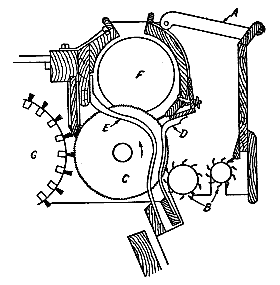
To take the place of a hand holding the seed, he made a sort of sieve of wires stretched lengthwise. More time was consumed in making the wire than stringing it because the proper kind of wire was nonexistent.
To do the work of the fingers, which pulled out the lint, Whitney had a drum rotate past the sieve, almost touching it. On the surface of the drum, fine, hook-shaped wires projected which caught at the lint from the seed. The restraining wires of the sieve held the seeds back while the lint was pulled away. A rotating brush, which turned four times as fast as the hook-covered drum cleaned the lint off the hooks. Originally Whitney planned to use small circular saws instead of the hooks, but the saws were unobtainable. That was all there was to Whitney's cotton gin; and it never became any more complicated.
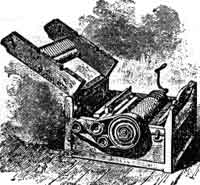
Whitney gave a demonstration of his first model before a few friends. In one hour, he turned out the full day's work of several workers. With no more than the promise that Whitney would patent the machine and make a few more, the men who had witnessed the demonstration immediately ordered whole fields to be planted with green seed cotton. Word got around the district so rapidly that Whitney's workshop was broken open and his machine examined. Within a few weeks, more cotton was planted than Whitney could possible have ginned in a year of making new machines.
The usual complaint of an inventor was that people were reluctant to give his machine a chance. Whitney's complaint was just the opposite. Before he had a chance to complete his patent model, or to secure protection, the prematurely planted cotton came to growth. With harvests pressing on them, the planters had no time for the fine points of law or ethics. Whitney's machine was pirated without a qualm.
Whitney had gone into partnership with Miller. The agreement was that Whitney was to go north to New Haven, secure his patent, and begin manufacturing machines, while Miller was to remain in the South and see that the machines were placed. Having no precedent of royalty arrangement to go on, the partners' first plan was that no machine was to be sold, but simply installed for a percentage of the profit earned. Since they had no idea that cotton planting would take place in epidemic proportions, they did not know that they were asking for an agreement that would have earned them millions of dollars a year. It had been Miller's idea to take one pound of every three of cotton, and the planters were furious. Cotton, one of the easiest growing crops, was coming up out of the ground in white floods that threatened to drown everyone.
By the time Whitney and Miller were willing to settle for outright sale or even a modest royalty on every machine made by someone else, the amount of money due them was astronomical. He and Miller were now deeply in debt and their only recourse was to go to court; but every court they entered was in cotton country. At length in 1801, eight years after the holocaust started, Miller and Whitney were willing to settle for outright grants from cotton-growing states in return for which the cotton gin would be public property within the boundaries. Even at that, only one state made a counter offer of half the asking price. Whitney accepted the price of $50,000 for which he received a down payment of $20,000 and no more.
The following year, North Carolina followed along in a slightly different fashion, levying a tax on every gin in the state. This sum, less 6 per cent for collection, went to Whitney and Miller; it came to another $20,000. Tennessee paid about $10,000, and there was another $10,000 from other states. The gross income was $90,000, most of which was owed for legal costs and other expenses. In 1803, the states repudiated their agreements and sued Whitney for all the money paid to him and his partner. That year alone the cotton crop earned close to ten million dollars for the planters. The price of slaves had doubled, and men's consciences no longer troubled them. Manumission was a forgotten word.
The following year, 1804, Whitney applied to the federal Congress for relief and, by one vote, was saved from total ruin. He was penniless, and his patent worthless, he was thirty-nine years old, and most of the past ten years had been wasted either in courtrooms or in traveling from one court to another.
He turned his back on cotton, the cotton gin, and the South forever.
Returning to New Haven, he resolved to start over. He did not know at first in which direction to go, but he was about to enter the less celebrated but most fruitful time of his life; and just as he had changed the face of the South, he was now about to mold the face of the North into a form it has kept ever since. He was to lay the foundation and invent the techniques for what has become known as the "American System of Manufacture."
In the early American republic, there was only a handful of skilled machinists. Better than anyone, Whitney knew how small that number was. He then proceeded to invent something far more important than a machine; he invented a system of manufacture which would permit an unskilled man to turn out a product that would be just as good as one made by a highly trained machinist. He put this system to work on the manufacture of rifles. Without a factory, without even a machine, he persuaded the U. S. government to give him an order of ten thousand muskets at $13.40 each, to be delivered within two years. Only Whitney's prestige as the inventor of the cotton gin could have swayed the government to make such a commitment. From anyone other than Whitney, the claim would have sounded insane.
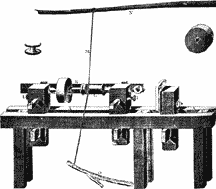
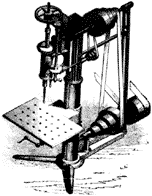
Until then, every rifle had been made by hand from stock to barrel; but the parts of one gun did not fit any other gun, nor did anyone expect them to. It was Whitney's idea to make all the parts of his rifles so nearly identical that the machines parts could be interchangeable from one gun to another. He did this by designing a rifle. For each part of the gun, a template was made. This was identical in principle to the dress pattern. A man would follow this pattern in cutting a piece of metal. Whitney then had to invent a machine that would allow a man to cut metal according to a pattern. The metal plate to be cut was clamped to a table, the template to be followed would be clamped on top of the metal, and a cutting tool would follow the outlines of the template. Ordinarily, a chisel would be such a tool. A chisel, however, required skill. Whitney took an iron wheel and cut teeth into the circumference so that it looked like a gear. However, the edge of each tooth curved slightly, sharpened to a cutting edge and then hardened. As the wheel rotated, one tooth after another came in play. Each tooth was then a separate chisel, but each chisel stroke was exactly the same, and the rotation of the wheel gave a steady cutting stroke. This wheel with its cutting teeth was then driven around the edge of the template. No great mechanical skill was needed.
This invention, subordinate to the entire system, was itself a major innovation. It was called the milling machine, and remained unchanged in principle for a century and a half. For various duties, Whitney designed many different varieties of millers. Before a single workman walked into his factory, Whitney worked out and built all the machinery he would need for his method of production.
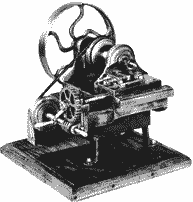
Whitney's New Haven friends had put up bonds amounting to thirty thousand dollars. He himself borrowed from the New Haven bank the sum of ten thousand dollars. The money involved in the order, $134,000, made it the biggest single financial transaction in the country. At the end of the first year, he was just getting into production, a marvelous feat by any standards; but instead of the four thousand muskets he had promised there were only five hundred to show. A commission from Washington handed in an unfavorable report and Whitney's backers looked drawn and thoughtful.
Almost eight years was required for Whitney to fill the order, because practice still showed many gaps in his system. The number of details seemed endless. However, most of the ten thousand were turned out in the last two years. In 1811, Whitney took an order for fifteen thousand, and these were turned out within only two years.
Whitney was a man on a large scale. There would have been every reason for him to have been embittered by his experience with the cotton gin, but he was too full of the essence of true creativeness. His letters to Fulton describing his experiences are full or remembered anger, but it is the anger of a man who was fighting. His friendships were warm and they lasted. He gambled on his talent, but in the way an artist does.
Like Hamilton, he believed that the factory was a benefit to America. Unlike Benjamin Thompson, he did not despise the people who worked in his factories. He also invented a pattern for the relationship between factory owner and the working hands; but of all his inventions this was the shortest-lived. Within a decade after his death, the American factory began to turn into something quite different from Whitney's design.
The same forces that overwhelmed him in the days of the cotton gin were to engulf the American factory.

Unless otherwise noted, content on this site is licensed under a Creative Commons Attribution-Noncommercial-Share Alike 3.0 License.
During the summer, we teach summer camp classes during the day here in the Museum.
Monday – Friday, Office Hours 9am – 5pm
Walk-in Projects available during open hours on
Saturday and Sunday.
Saturday: 10am – 3pm
Sunday: 10am – 3pm
Phone: (203) 777-1833
Fax: (203) 777-1229